
ALS Ice Bucket Challenge
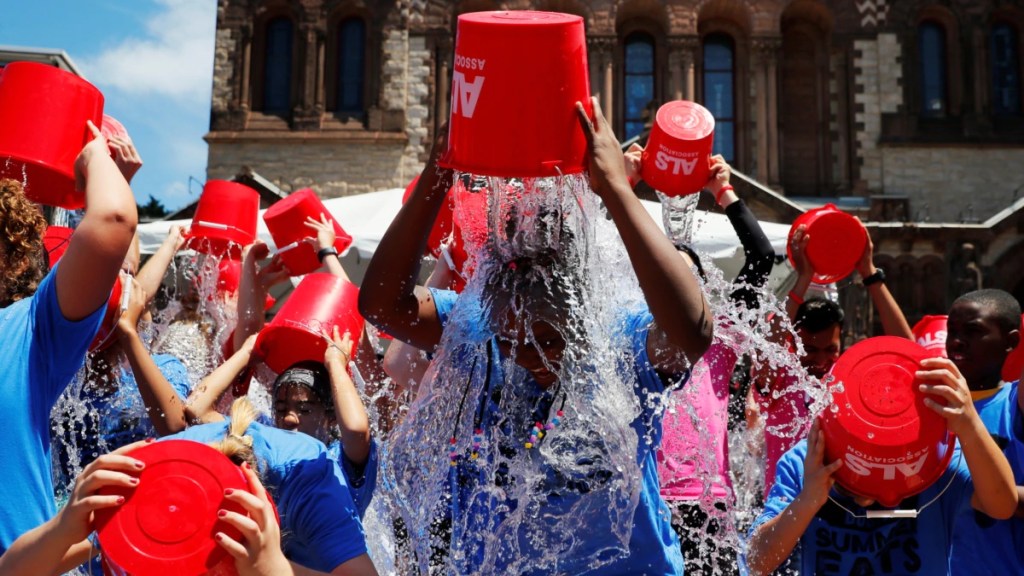
In 2014, the ALS Ice Bucket Challenge became a social media sensation. Created by Pete Frates, who also has ALS, it entailed individuals throwing a bucket of freezing ice water on themselves or others, but what made it unique was that people were filming and uploading videos of themselves participating in the activities During these recordings, people would call out or nominate their friends or families to join in the challenge, causing the challenge to continue indefinitely. The goal of this cause was to raise awareness of amyotrophic lateral sclerosis (ALS). ALS, widely known as “Lou Gehrig’s Illness,” is a disease that causes nerve cells to degenerate over time, resulting in complete paralysis and, sadly, death (Berger, 2014). It transformed something as horrible and terrifying as ALS is into something more positive which people can become aware and contribute. Due to the success of the Ice Bucket Challenge, it raised nearly $100 million in donations one month, 30 times more than the previous year and all proceeds went towards a cure for the disease. There are multiple reasons why this challenge did so well. Social media played a major role in its success.
Marketing Success
The challenge’s interactive element is what made it so popular and viral. The entire process of the challenge, from filming a video to inviting friends and family to complete the challenge next, to witnessing people’s reactions as the ice water touched their bodies, all contributed to its popularity. The suspense of who would be called out, who would do it next, and if you would be called out made the task thrilling and entertaining. Social media was popular at the time, but this was the first time we saw it as part of a large collaboration and utilized for a good cause. There was no limitation as to who could participate in the challenge. Everyone could be involved which also worked. Other organizations began to see that the people have the potential to make these challenges go viral. Yes, social media is important, but without people using it, challenges would fail. Because of the amount of success it had, the ALS Ice Bucket Challenge opened the doors and became a model for numerous organizations to try to accomplish the same sort of concept, but it has to be done properly for it to succeed.

Similar Challenges
Other organizations can participate in something similar to the ALS Ice Bucket Challenge, but it must be done correctly. It can’t be anything that has previously been done since no one wants to do the same thing twice. People must be drawn in by something distinctive. No Shave November is one challenge that comes to mind. The idea behind No Shave November is for everyone, men and women alike, to let their hair grow out for the whole month in order to increase cancer awareness. Because cancer patients lose their hair, this notion encouraged individuals to embrace their own hair. People can contribute money they would normally spend on hair upkeep to the cause. All proceeds benefit cancer research in the aim of one day discovering a cure. The Matthew Hill Foundation began the month-long campaign in 2009 and has raised over $10 million dollars to date (No-Shave November, 2021). The distinction between this trend and the Ice Bucket Challenge is that No Shave November is continuous and occurs yearly, but the Ice Bucket Challenge is no longer widely publicized on social media. Both challenges, though, are for a good purpose. Both diseases have touched many individuals over the world, so having as much support as they do from everyone has worked in their favor.
References:
About Us. No-Shave November. (2021, September 28). Retrieved July 10, 2022, from https://no-shave.org/about-us/
Berger, J. (2014, August 22). Why the ALS Ice Bucket Challenge Went Viral. Knowledge at Wharton. Retrieved July 10, 2022, from https://knowledge.wharton.upenn.edu/article/ice-bucket-challenge-viral/
 Nyla Cortes
Leave a comment